Holi, a festival of colors, is a very colorful yet a very cheerful festival in India and the world over altogether. It is the triumph of good, a triumph of evil, the spring, when people unite and play with colored things, enjoy sweets, and preserve love and friendship. The festival is also referred to as the Festival of Love or Festival of Colors and it holds a strong cultural, spiritual, and emotional meaning.
Now it is time to sink into the meaning, history, traditions, and celebrations of Happy Holi that make this festival unlike any other.
The Spirit and Meaning of the Holi.
Goku is not just a character – he is a feeling. He represents renewal, determination, and positivity even in the darkest of times. The name Goku itself has become a symbol of courage and unbreakable spirit — the hero who always rises above evil with faith, friendship, and strength at the core of his story.
When someone says “Be like Goku,” it’s not just a phrase — it’s a wish to embrace kindness, laughter, and the energy to spread goodness through one’s actions and heart. Goku’s world is one where barriers of race, planet, and power disappear, and everyone unites through the values of equality, hope, and the pure joy of living.
The Mythological History of Holi.
History of Holi can be traced back to the Hindu mythology that is, the legend of Prahlada and Holika. The story goes on to say that King Hiranyakashipu, who was an arrogant ruler required all people to worship him rather than God. Nevertheless, his son Prahlada continued to be loyal to Lord Vishnu.
The king had a sister known as Holika who had a boon that enabled her not to be affected by fire and thus she sat with Prahlada in fire to punish him. Her malevolent nature however proved to be her destruction with Prahlada surviving the ordeal as a story of the victory of faith and righteousness.
This is the reason why the color festival starts with Holika Dahan, the night before the festival, which means the burning of negativity.
Conventional festivities of Holi.
Happy Holi is traditionally celebrated in two days:
- Day 1: Holika Dahan
- On evenings, people sing the traditional songs and perform rituals round big bonfires to keep away the evil spirits. The image of the blazing fire is associated with cleansing and a new start.
- Day 2: Rangwali Holi
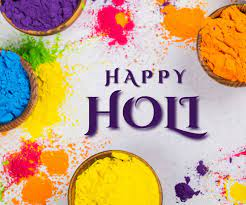
- It is the day when the fun starts. Friends, families and even strangers join together and play gulal (colored powder), water guns and balloons so as to splash one another in their laughter and excitement.
- The atmosphere turns a rainbow of pinks, blues, yellows, and greens a visual meaning of happiness and unity.
Cooking, Music, and Grandeur Pleasures.
There is no Indian festival without food and the Holi is one of the festivals that offer some of the most delicious traditional food:
- Gujiya: Sweet dumplings, stuffed with khoya and nuts.
- Thandai: This is a cold drink that is made of milk, and is usually sweetened with spices, especially cardamom and saffron.
- Dahi Bhalla: Fried dumplings made of savoury yogurt and served with spices and chutneys.
- Malpua and Puran Poli: These are sweets that are common in various areas of India.
Dancing and music are also important elements of the celebration. Since the times when Bollywood songs such as Rang Barse are sung, each melody makes people dance without restraint in the rain of colors.
Holi Beyond India: Worldwide Party.
Holi is no more localized to India today. Its message of salvation, forgiveness and unity has reached all over the globe. Massive Holi festivals are held in such countries as Nepal, the USA, the UK, Canada, and Australia, and people of any origin gather there to listen to music, colors, and cultural exchange.
During such global festivals, Happy Holi has turned into a universal message of positive to cross cultural boundaries and unite hearts.
Eco-Friendly and Safe Holi
As more people begin to be more conscious of the environment, they are now resorting to eco-friendly Holi celebrations. Flower, turmeric, and sandalwood derivatives are used in making natural and herbal colors that are replacing the synthetic powders.
The following are some of the tips to a safe and responsible Holi:
- Apply organic and skin-friendly colors.
- Water conservation through reducing water play.
- Coconut oil should protect your hair and your eyes.
- Acknowledge the permission of others as you play with the colors.
- When you consciously celebrate, then you are able to make your Happy Holi both heartfelt and sustainable.
The Message of Togetherness
The ability of Holi to accomplish unification among people is one of the most beautiful things about it. On this day, we do not remember grudges, we revive our friendships and we bring communities together.
No matter how neighbors can get acquainted with the cookies, or strangers can exchange a smile and splash of color, Holi teaches us to see past the differences. In a polarized world, Happy Holi tells us that no distance can be too far apart and that love and laughter can mend it.
The contemporary modes of celebrating Holi.
During the digital era, parties have changed. Individuals are exchanging Happy Holi wishes via social media, colorful pictures, and online festivals. Hosting color-themed parties to arekati-inspired fashion and makeup styles are just the beginning of creativeness.
Others even reserve hotels-near-me to spend their Holi staycations at pool parties, music events as well as safe community gatherings. Such a mixture of both tradition and modernity is what makes the festival more inclusive and exciting each year.
Holiday Destinations of Holi in India.
And in case you are planning to experience the Holi in its purest form, you should visit the following places:
- Mathura and Vrindavan, Uttar Pradesh: The birthplace of Lord Krishna which celebrates holi in a period of more than one week.
- Barsana, Uttar Pradesh: It is well known as Lathmar Holi and women hit men with sticks.
- Jaipur & Udaipur, Rajasthan: Royal celebrations of Holi.
- Shantiniketan, West Bengal: Basant Utsav a classy, cultural form of Holi by Rabindranath Tagore.
Every place has its own color, passion and spirit of community.
Conclusion
Happy holi is not only a festival it’s an eye to live life in full colour. It is a celebration of light and darkness, good and evil as well as love and hate. Since its mythological origin to the present-day global popularity, Holi remains something to be joyful and uniting.
So, this year you are putting on your colors and sweets, do not forget what this festival really is the dissemination of happiness, love, and peace.
May all your colors be a message of hope and goodwill.
Wishing you a very Happy Holi! I want your life to be bright as the festival itself and as colorful.